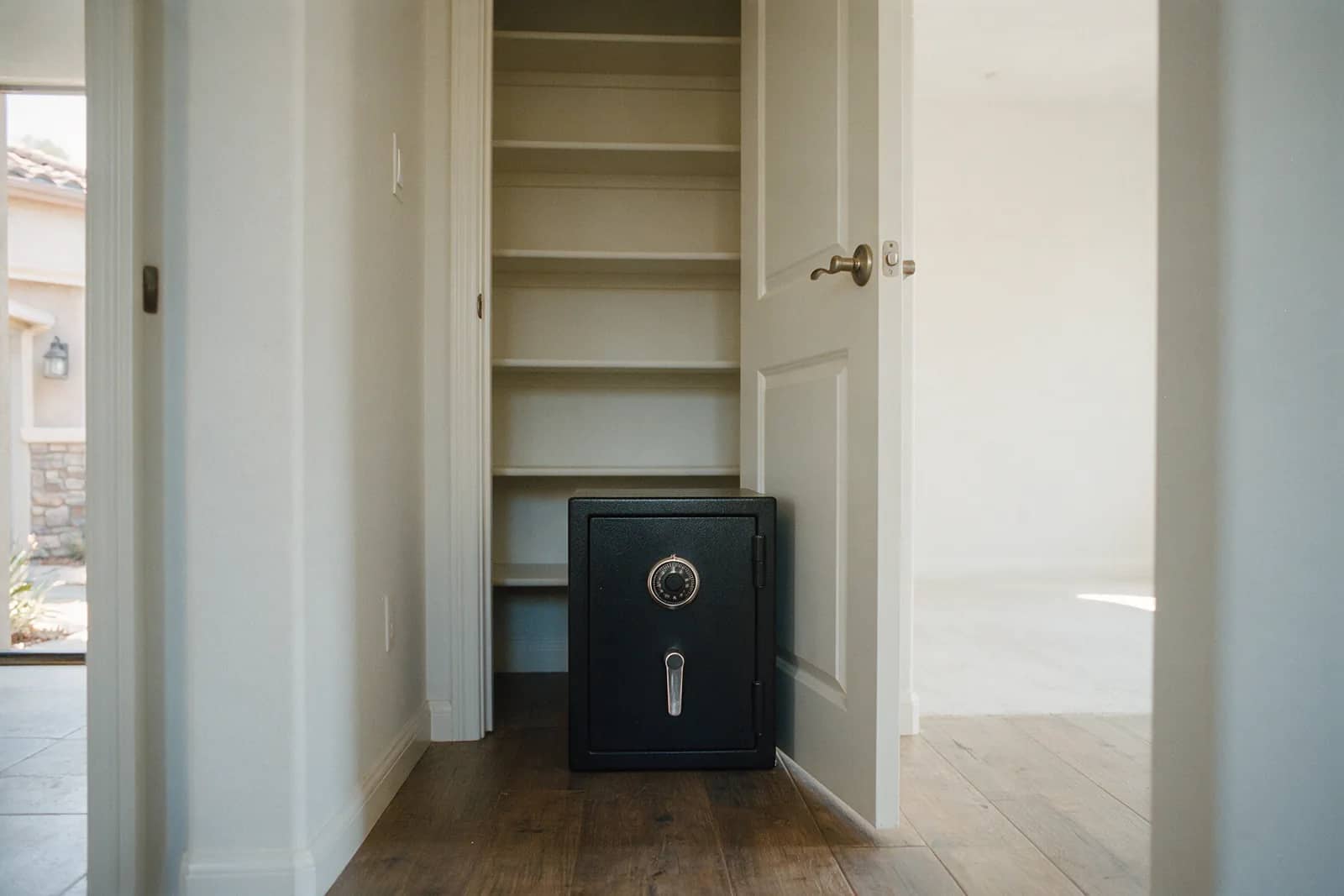
Bolted to the closet floor, and not mentioned anywhere in the sale
You find it in the first week. A gray box on the floor of the primary closet with a dial on it, bolted down through the slab, or a taller cabinet standing in the corner of the garage behind where the shelving used to be. The sale paperwork does not mention it. The agent does not know. The sellers are two states away and, when asked, remember that it was there when they bought the place in 1998.
Nothing about this is urgent, which is worth saying because people treat it as though it is. The safe is not going anywhere, nothing in it is deteriorating this month, and there is no version of this where rushing improves the outcome. It is one of the nine things on this property that takes a key or a code, and it is the one that sat untouched the longest.
It is also the item most often handled badly by the household before anybody calls. Somebody tries the dial a hundred times with numbers from a birthday. Somebody pries at the door edge with a flat bar. Somebody borrows an angle grinder from a brother-in-law. All three make the eventual job longer, and the third one usually destroys a box that was worth keeping.
First establish what kind of box you are looking at
There are three broad families and they price and behave differently. A fire box is a light cabinet whose purpose is to keep paper from charring for an hour or two: thin steel, a thick insulating layer, a simple lock, often a keypad running on cells. A security safe has real steel plate, a proper bolt work, a relocker inside, and a dial or an electronic lock rated for it. A gun cabinet sits between the two and varies wildly. What you have decides almost everything after it.
Then the lock on the front. A mechanical dial with numbers around it and a handle below. An electronic keypad with a battery compartment behind the keypad ring. A key-only door, which is common on older fire boxes. On a keypad, look for a small round port or a plug at the bottom of the door, because a good many of them have a key override behind it that the household never knew existed.
Finally, look for numbers. The serial is usually stamped on the back, the top, the hinge side or the inside of the door frame. On a mechanical dial, the manufacturer name is on the dial ring itself. A phone photo of the dial, the handle, the keypad and any serial stamp is the single most useful thing you can send before a visit, because it decides what tooling comes on the van and it can change the quote.
The free things to try before anybody is paid
Ask backward through the sale. The listing agent, the agent who represented the sellers, the escrow file, and the sellers themselves. Combinations turn up written on masking tape inside a kitchen cabinet, in a phone note, or on the back of the manual in a box of paperwork in the garage. It costs two emails and it resolves a fair share of these.
On an electronic keypad, try the factory code before anything else. Nearly every consumer keypad ships with a default from the manufacturer, printed in a manual that is on the internet, and a surprising number of safes in this city are still running on it because the original owner never changed it. While you are there, put fresh cells in. A keypad with tired batteries produces exactly the same symptom as a keypad with a wrong code, and the number of safes that are not actually locked out is not small.
If the safe is a known brand and you can find the serial number, the manufacturer will often supply the original combination or a factory key code to a verified owner. Expect to prove ownership with the deed or the closing paperwork and to wait a couple of weeks. That is the slow, cheap route, and it is the right one when nothing inside the box is needed this month.
How an opening is actually done
The first choice is always to open it without cutting anything. On mechanical dials that means manipulation, working the wheels and reading what the lock gives back, which takes patience and works on a decent share of older boxes. On keypads it may mean a key override behind the plug, or the factory reset path the manufacturer publishes to a verified owner. On key-only doors it is often straightforward lock work, because the lock in a light fire box is rarely a serious one.
When that does not work, the job becomes a small hole in exactly the right place rather than an attack on the door. A scope goes through it, the bolt work or the lock is read directly, and the safe is opened using its own mechanism. The location of that hole is the entire skill: through the door face, through the top, or through the side, chosen so that the relocker is not triggered and so the hole can be plugged afterward. It is quiet, slow work and there is no violence in it.
What does not happen is a grinder on the door edge or a pry bar at the hinge. Both of those turn a safe into scrap, take longer than doing it properly, and on a fire box they set the insulation on fire in front of you. If the household has already tried that before calling, say so on the phone, because a deformed door changes the approach and the time.
What it costs, and what happens to the safe afterward
Safe opening is $216 to $570, with the $89 service call counted inside that figure rather than added at the end. The spread is wide because the work genuinely varies: a light fire box with a keypad override sits near the bottom, a mechanical dial that manipulates open lands in the middle, and a heavy security box that needs a hole drilled and then properly repaired sits at the top. A photo of the door before the visit narrows that considerably.
The work happens where the safe stands. Nothing is hauled to a shop, and that matters when the box is bolted through a slab in a closet or sitting on a garage floor nobody wants to drag it across. Plan on the closet being clear and on somebody being home for the whole visit, because ownership gets checked before any tool comes out and the box does not get left open and unattended.
If a hole was drilled, it gets plugged and the lock is put back into service, or a new lock is fitted where the old one was the problem. A safe repaired this way keeps working and keeps its rating for what it is. You get a combination you choose yourself, and the advice is to write it somewhere that is not inside the safe. Labor carries 90 days.
Who gets to open it, and what we ask for
Ownership is established before anything starts, and on an inherited or inherited-with-the-house safe that is a slightly longer conversation than on a front door. The deed, the closing paperwork or the escrow statement with your name and the property address on it does the job, alongside photo identification. This is not procedure for its own sake. A safe is the one object in a house where the contents may belong to somebody who is not standing there.
Where the situation is genuinely tangled, a rental where the box belonged to a previous tenant, an estate that is not settled, a property held by more than one party, we say plainly that it is not this trade's call to decide who has the standing to order the work. That gets worked out between you and the people involved, and the visit happens once it is settled. It is a short conversation on the phone and it is better had then than on a doorstep.
If the contents turn out to belong to the sellers, which happens more often than people expect with documents and jewelry, the sensible route is to photograph what is in there before touching it and contact them through the agent. Most of these end with a box being mailed back and nothing else happening.
Keep it, move it, or get rid of it
Once it is open, decide honestly whether you want a safe at all. A real security box bolted through a slab is worth keeping and worth putting a fresh lock in. A light fire box in a garage is worth about what a new one costs, and the opening you just paid for is most of the value of the object. There is no obligation to keep a thing purely because it came with the house.
If you keep it, three things finish the job. Set a combination nobody else has ever held. Check that it is actually bolted down, because a box that two people can carry out to a truck is a container rather than a safe. And open it once every couple of months even when you do not need to, which keeps a mechanical lock honest and tells you about a dying battery before it strands you.
If you are getting rid of it, an open safe is easy to move and a locked one is not, which is another argument for opening it rather than leaving it in the corner for three years. Arrival averages 19 minutes across the city from the base near Main Street, with Downtown at 12, Val Vista 15, Mission Park 16, Vintage Hills 19 and Ruby Hill at 26. This is daylight work by preference, but if it has to be evening, $52 applies between 8pm and midnight and $94 between midnight and 7am, named before anyone drives.
Quick answers
Can a safe be opened without wrecking it?+
In most cases yes. The first attempt is always to open it through its own mechanism: manipulation on a mechanical dial, a key override or factory path on a keypad. Where that fails, a small hole goes in a chosen spot, the lock is read through a scope, and the hole is plugged and the lock returned to service afterward. What ruins a safe is a grinder or a pry bar, not a proper opening.
What does it cost to open a safe that came with the house?+
Safe opening is $216 to $570 with the $89 service call counted inside the figure. A light fire box with a keypad override sits near the bottom of that, a mechanical dial in the middle, and a heavy security box needing a drilled and repaired hole at the top. Send a photo of the door, the dial or keypad and any serial stamp, and the quote narrows before anyone drives.
What do I need to show before you open it?+
Photo identification and paperwork tying you to the property, such as the deed, the closing statement or the escrow file. On an unsettled estate or a box a previous tenant left behind, it is not this trade's call to decide who has the standing to order the work, and that gets settled before the visit rather than on the doorstep.
Need it handled rather than read about?
(925) 940-2823More guides