About
A town where the door opens without a key.
One van, out to any of the nine doors at any hour: a front door in a seventies tract before the school run, a pool gate on the first warm weekend, a cellar under a house that changed hands in spring, a side gate on a hillside lot whose key nobody has seen in years. Cylinder stock, a key machine and the pinning kit ride with it, so a key gets cut and tried on the same visit rather than on the next one. This is how a call runs.
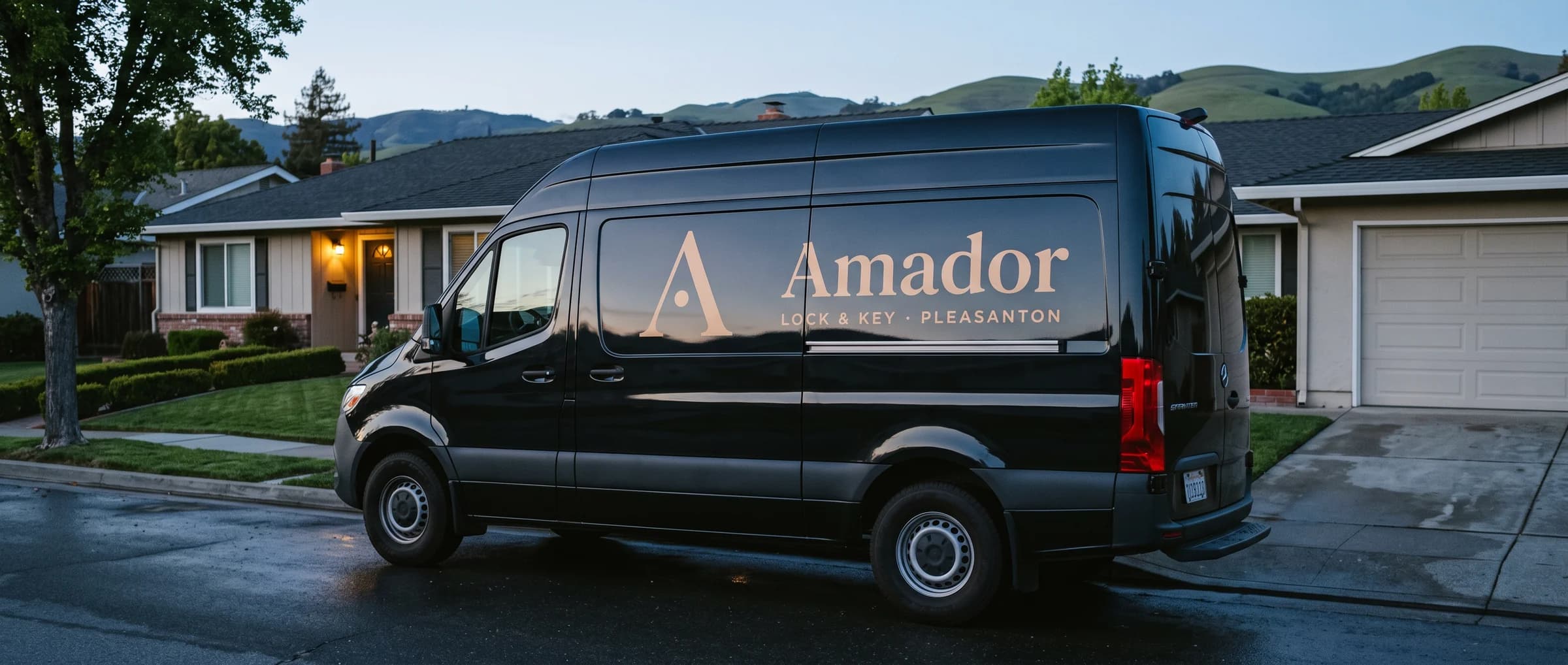
Amador Lock & Key works Pleasanton out of a van, day and night, holidays included. There is no shop front to call in at, and there is no point in one: a gate, a jammed entry or a safe in a closet cannot be picked up and brought in, so the workshop drives to them. The van starts downtown, a few doors off Main, which puts the eight parts of the city between 12 and 26 minutes away: Downtown about 12, Val Vista 15, Mission Park 16, Birdland 17, Vintage Hills 19, Stoneridge and Hacienda 21, Foothill and Castlewood 24, Ruby Hill 26. Averaged across the eight, that is 19. Dublin at roughly 22 minutes, Sunol 24, Livermore 26, San Ramon 29, Danville 32 and Castro Valley 35 are charged from the same list. The name comes from the Amador Valley, the floor of dry hills this whole town sits on and the answer most people here give when somebody asks where they live.
One sentence covers most of the work in this city: the front door is one of nine. A house here is not a door, it is a set — the entry, the service door on the side of the garage, a side gate, a pool gate that has to latch itself, a cellar, a safe, the room over the garage, a mail block at the road and, on the hill streets, a gate standing before the driveway even begins. Every one of them has a key, and the keys have scattered. The gardener has the yard gate. The cleaner has the entry. Two contractors from the last remodel still hold whatever they were handed in 2019 and never gave back. Nobody in the house can say how many copies exist, which is why the same two calls come in week after week: open the door that stopped me today, and bring all of this onto one key. The doors also fail in a predictable order. The gate latch goes first, because a gate nobody walks through from September to June dries out until the key turns and moves nothing. Then the garage service door, carrying the cheapest lock on the property and standing as the second way into the house. Then the entry itself, usually on a seventies frame settled far enough that the bolt catches the edge of its plate instead of dropping through. So nobody here opens a call by asking what make of lock is on the door. The two things worth knowing are which of the nine it is, and how long since a key last went into it.
Every street in Pleasanton is charged from the same sheet, and $89 of whatever it says is the drive, folded in rather than tacked on. House lockout $134–$255. Car lockout $112–$208. Business lockout $148–$276. Putting a forced door back together $181–$472. Rekeying works out at $34–$52 a cylinder, the second and third cheaper than the first because nobody drives out twice. New hardware $132–$352; a keypad or app lock $208–$515; a safe opened in the room it stands in $216–$570. On the commercial sheet, exit devices are $324–$836 a door and shop front hardware $166–$505 an opening; master keying and access control get no number until somebody has walked the doors with a notebook. Vehicles: $164–$446 for a car key, $99–$208 to pair a remote, $194–$487 for an ignition, $132–$308 for motorcycle keys. Evenings from 8pm add $52 and nights past midnight add $94, both inside the total before you agree to it, while Saturdays, Sundays and holidays add nothing whatsoever. Labor is warranted 90 days and it says so on the invoice. Three things are deliberately missing from the sheet: anything to do with a garage door's springs, its cables, its panels or the motor that lifts it, which is a separate trade; remotes and gate lists for a community, which the association controls; and any ruling on which resident may order work on a door shared by many households, which gets settled on the call between you and whoever runs that door.
Every Door on the Property
Four commitments written for a house with nine ways into it. Two of them are numbers and two are rules, and all four are spoken while you are still on the phone — never discovered later, on a driveway, with a technician already unpacking.
- Castlewood, Ruby Hill and the streets climbing south — large lots, long driveways, a gate before the house
- the hill streets
- Val Vista, Mission Park and the flat streets west of Main — houses from the sixties and seventies, one household per door
- the tracts
- Main Street and the blocks around it — small buildings with shared street doors and offices above shops
- downtown and the condos
Where we work
Pleasanton and the Tri-Valley, any hour
Pick your area for its own arrival time and the jobs we run there most.
Open 24 hours, 7 days
Name the door, and say how long since anyone used it
Pleasanton, whatever the hour, every day of the year. An entry in the tracts, a seized gate latch on a hill street, a pool gate, a safe left behind by the last owners, a shop door on Main, a car sitting in the Stoneridge lot — that is what decides the work, and the work decides the figure. You get that figure on this call with the $89 drive and the clock already inside it, and it is the figure on the invoice. Ninety days on the labor, in writing. The van is a few doors off Main.