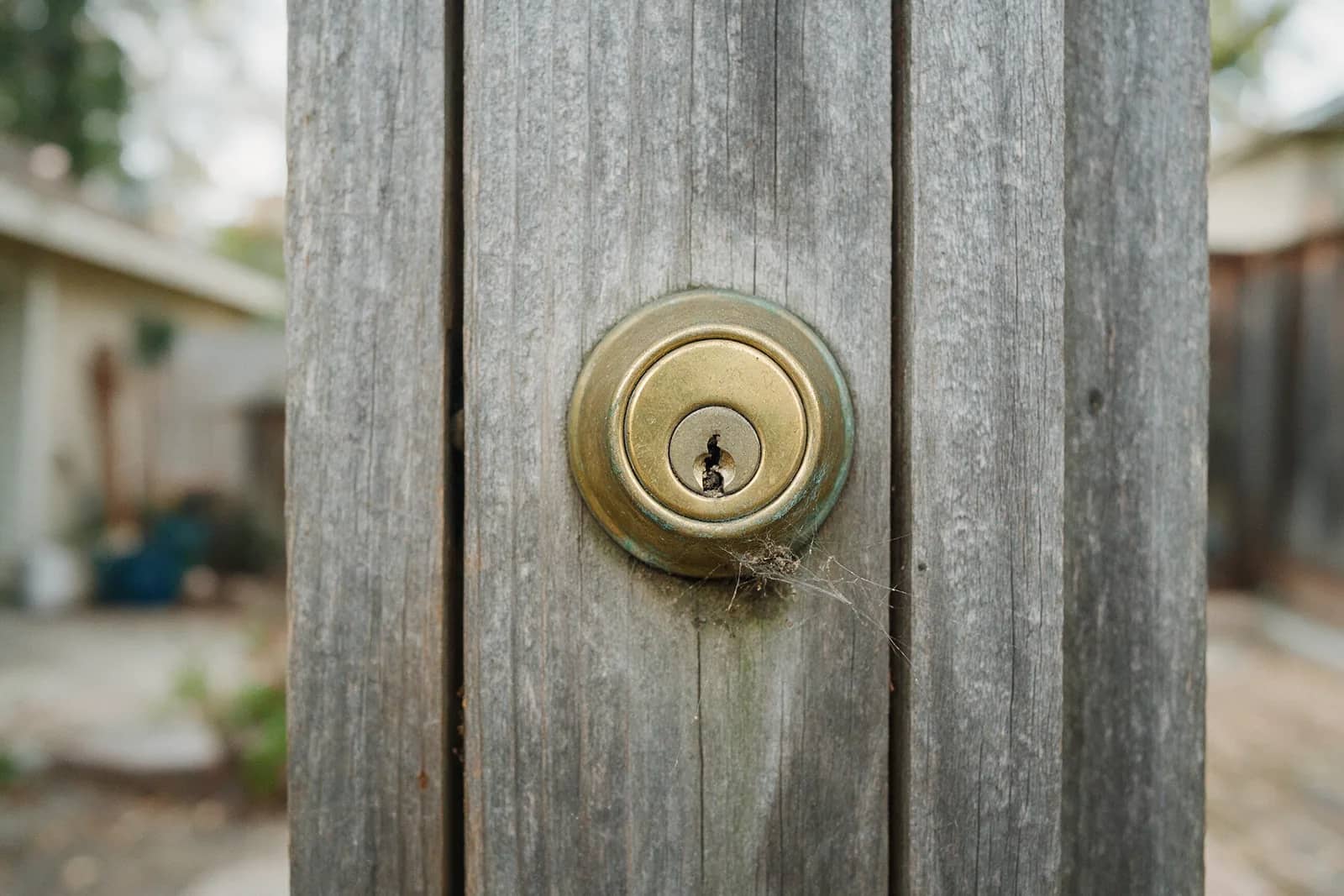
The key goes in, turns, and nothing happens
It is usually a Saturday in spring, and somebody wants to get a wheelbarrow through the side gate for the first time since last summer. The key goes in about two thirds of the way and stops. Or it goes in fine, rotates a quarter turn with no resistance at all, and the latch on the other side does not move. Or it turns halfway and then sits there, and the honest instinct at that point is to lean on it, which is exactly the move that ends with half a key in a cylinder.
The gate itself looks fine. That is what makes the moment confusing. Paint is sound, the frame is straight, the hinges swing. The only part that failed is a brass cylinder the size of a thumb, and it failed because it is the one piece of the property that got neither use nor attention for twelve months.
This call comes in all year and peaks twice: the first warm weekend, when the yard work starts, and the first week the pool gets opened. Both times the story is the same. The gate was fine in August, nobody touched it after that, and in March it is a different object.
What actually happened inside a cylinder that sat still
Start with what a pin tumbler needs to work: five or six small pins that drop into place under light spring pressure, with a few thousandths of an inch of clearance around them. Anything that fills that clearance stops the mechanism. Yard dust blows into a vertical keyway all summer. Whatever lubricant was in there when it was new has long since dried into a varnish. Neither of those is dramatic, and together they are enough.
Then water. Nearly every side gate in this city stands inside the arc of a sprinkler, and a cylinder takes that spray at head height four mornings a week. Water carries the dust further in and leaves mineral scale behind when it dries. On a gate that gets afternoon sun the metal runs far hotter than the air, which cooks the whole mixture into place. The cylinder facing a shaded fence line usually survives longer than the one that faces west.
Last, the parts around it. A wood gate sags on its hinges the way a door does, so the latch bolt starts meeting the edge of the keeper instead of the middle. Now the key has to turn a bolt that is pressed against metal, which needs force a cylinder was never built to take. The cam wears, then rounds off, and that is the version where the key rotates freely and nothing moves.
Why the gate goes before the front door does
Count cycles. A front door is opened and closed a few thousand times a year, which keeps the pins moving, wipes the keyway, and tells somebody the moment it starts to feel different. A side gate sees perhaps twenty cycles. A pool gate in a house with no small children sometimes sees two. Low use is not gentle use. It is no use, and a mechanism with clearances this small needs movement more than it needs protection.
Add the exposure. A front door stands under an overhang, behind a screen, out of the sprinkler line, in shade for most of the day. The gate is on the property line with weather on both faces and nothing over it. The two locks may have come out of the same box on the same afternoon and they are not living the same life.
That gap is the reason gate work sits at the top of the call list here. It is also why the price of a job moves inside its range: what took the lock is not the only question, how long it sat untouched is the other half. A cylinder that seized this winter cleans up. One that has been stiff for three seasons and forced every time is usually past cleaning.
Five minutes before anybody forces anything
First, prove the key. Try the same key in a lock you know works, or try a different copy of it in the gate. A key that has been in a pocket with coins for two years wears its cuts down, and a worn key fails first on the tightest cylinder on the property, which is always the gate. Half of these are a key problem wearing a lock problem's clothes.
Second, take the load off. Lift the gate leaf slightly and push it toward the latch, then try the key again with the other hand. If it turns with the weight held and refuses when you let go, the gate has dropped and the lock is fine. That is a hinge and keeper job, and no new cylinder will improve it.
Third, stop before the oil can. The general purpose spray from the garage shelf is the single most common thing that finishes off a gate lock: it thins what is left in there for about a day, then dries into a stickier film that holds dust better than the old one did. A dry lubricant is the right product and a clean cylinder is better than either. If it is already stiff enough to need force, the next turn is the one that snaps the key, and a broken key at the gate costs more than the honest repair would have.
What gets done, and what it comes to
The ordinary version: the cylinder comes out, gets cleaned dry rather than flooded, gets new pins and a key cut to match, and goes back in so it turns with two fingers. That is $34 to $52 per cylinder with the $89 service call counted inside the figure. While the technician is there, the other cylinders on the property sit at the low end of that range, because the trip is paid for once, and the gate is rarely the only lock that has been sitting.
The worn version: a rounded cam, a shell that has corroded from the inside, a keyway you can see daylight through. Then it is replacement with the hardware at $132 to $352, and the useful thing to ask for is a cylinder that matches the rest of the property so the gate finally joins the house key instead of keeping its own.
The gate itself is often half the work. Hinge screws driven into fresh wood, the keeper moved a quarter inch so the bolt lands in the middle of its hole, a sagging leaf brought back square. None of that is glamorous and all of it is what keeps the new cylinder from repeating the story in two years. Labor carries 90 days.
The pool gate is a stricter version of the same problem
A pool gate has to swing shut and latch by itself, which puts a closer and a self-latching catch into the arrangement. Those parts have their own failure modes and they are not lock work: a closer that has lost its tension, a latch mounted high on the gate that no longer catches because the leaf dropped half an inch. The cylinder in it is ours, the gate hardware around it is a separate conversation, and it is worth knowing which one you are describing on the phone.
What makes pool gates the worst offenders is usage. A household without small children may open it twice a year, and both of those times are the same week in June. Then the cylinder has ten months of dust, sun and irrigation with nothing turning in it. Every symptom in this article arrives faster there than it does at the side gate.
So the pool gate is the one lock on a property worth turning deliberately, without needing to. Twice in winter, once in spring, key in and out, bolt thrown and released. It takes fifteen seconds and it is the difference between a cylinder that lasts a decade and one that dies in its third summer.
Twice a year, and where the van is coming from
Pick two dates that are already in your head, a birthday and a holiday will do, and walk the outdoor locks. Key in, full turn, key out, both directions. Anything that needs a second hand gets written down and dealt with in daylight. That is the whole routine and it is shorter to do than to read about.
When it does need a visit, it is worth having in the afternoon rather than after a party when twenty people are on the wrong side of a gate. Arrival averages 19 minutes from the base near Main Street, with Birdland at 17, Vintage Hills at 19, Foothill and Castlewood at 24 and Ruby Hill at 26. An arrival between 8pm and midnight carries $52 and one between midnight and 7am carries $94, both named on the phone before anyone drives, so the figure agreed to is the figure on the receipt.
Quick answers
My gate key turns but the latch does not move. Is the lock finished?+
Usually the cam behind the cylinder has worn round after being forced against a bolt that was binding. The cylinder comes out and is judged on what is inside it. If it cleans up it is rekeyed at $34 to $52, and if the shell or cam is past it, replacement with the hardware is $132 to $352. The gate gets checked at the same visit, because a dropped leaf is what wore the cam in the first place.
Should I spray the gate lock with oil before calling?+
No. General purpose spray helps for a day, then dries into a film that holds dust better than what it replaced, and it is the most common thing that turns a cleanable cylinder into a replacement. A dry lubricant is the correct product. If the lock already needs force, the next turn is the one that breaks the key off inside it.
How often does an outdoor gate lock actually need attention?+
Turn it deliberately two or three times a year, even when you do not need to pass through, and have it cleaned and rekeyed when it starts needing a second hand. A side gate gets about twenty cycles a year against several thousand on a front door, and it sits in the sprinkler line and the afternoon sun, which is why it quits first on almost every property here.
Need it handled rather than read about?
(925) 940-2823More guides