The lift, the lean and the pull that nobody in the house remembers learning
Ask a household in Mission Park how they lock the front door and you get a piece of choreography rather than an answer. Lift the handle slightly. Put a shoulder on the middle of the leaf. Pull it toward you with one hand while the other turns the key. Then push harder on the second turn, and there is a sound somewhere between a click and a grind. Nobody was taught this. The ten year old in the house does it too.
That routine is the door saying something in the only language it has. A deadbolt is a steel bar that slides into a hole in the frame, and it is supposed to pass through the middle of that hole with clearance all the way around it. When it starts arriving at the edge, the only way to make it go in is to move the leaf, and that is exactly what the lift and the lean are doing.
The houses this shows up in went in as whole tracts in the sixties and seventies, on flat slabs, a street at a time. Mission Park and Val Vista are full of them. Fifty-odd years of wet Februaries, dry Septembers and doors pulled shut hard twice a day are enough to move a frame by an eighth of an inch, and an eighth of an inch is the whole margin the bolt had.
What moved, and it was not the cylinder
Start at the hinges, because most of it lives there. A solid exterior door is heavy enough to work its top hinge loose over decades, and the screws in that hinge are very often three quarter inch ones driven into the soft edge of the jamb rather than long ones reaching the framing behind. As the top hinge gives, the whole leaf rotates a fraction, the outer bottom corner drops, and the bolt two thirds of the way up swings down and inward with it.
Then the frame. Wood takes up moisture in winter and gives it back in a dry fall, and a jamb that has done that fifty times does not return to precisely where it started. Add the settlement any slab-on-grade house does in its first decades, add the shrinking of the framing behind the trim, and you get a jamb that is a little out of square. None of that is damage and none of it needs alarming language. It is a building behaving like a building.
Last, the small violences. Thirty years of a screen door spring yanking the leaf shut, a kid closing it with a foot, groceries pushing it with a hip. Each one works the strike plate screws a little looser in their holes, and a plate that has shifted a sixteenth of an inch does exactly what a settled frame does to the bolt. The difference is that the plate is four minutes of work.
Three free tests before anybody buys anything
Swing the door wide so the leaf hangs in open air, and throw the deadbolt with the thumb turn. It should run out and back with one finger. Now shut the door and do it again. Easy in the air and stiff when closed means the lock is fine and the alignment is not, and no hardware on any shelf changes that.
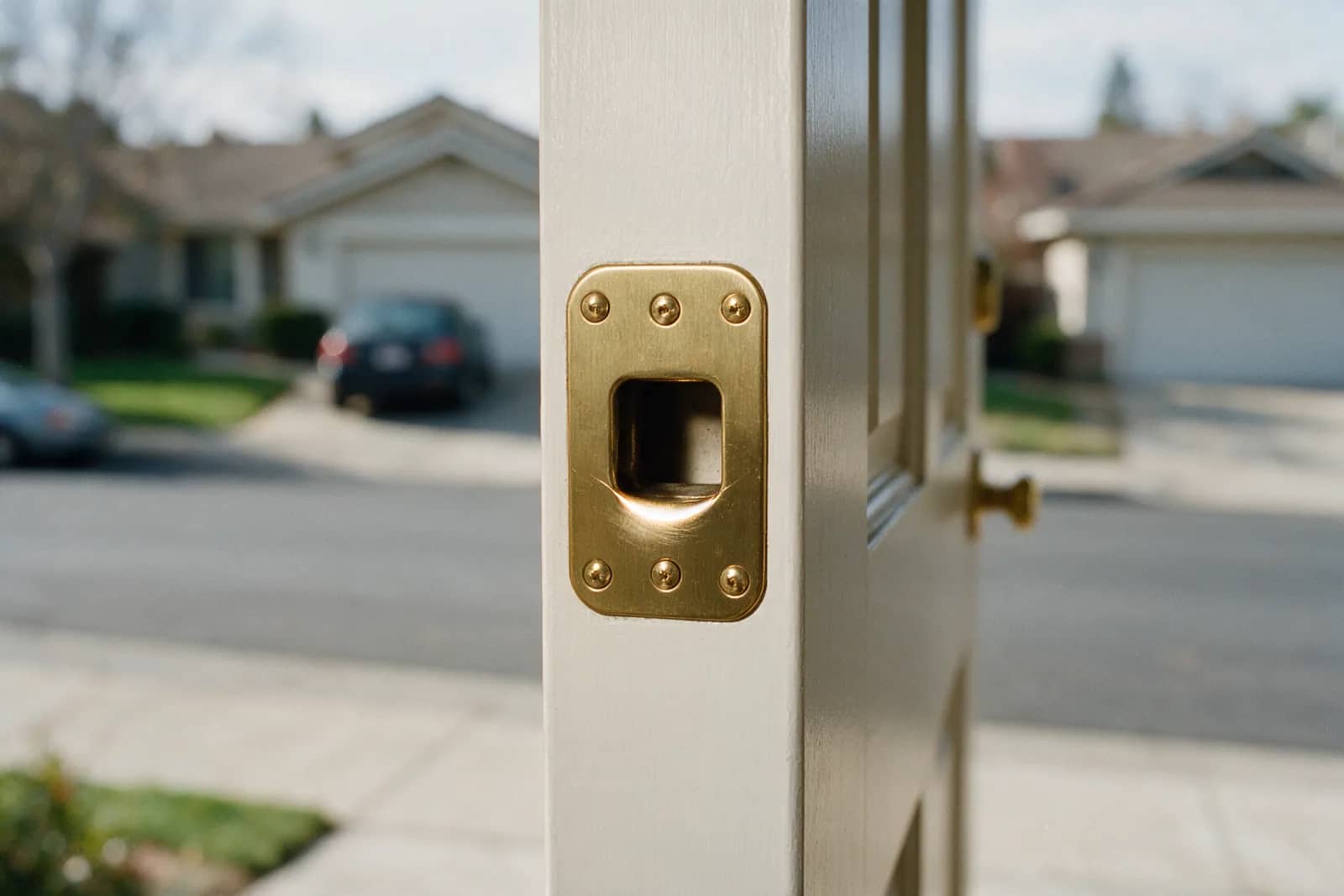
Look at the strike plate on the frame. A bolt that has been landing on the edge polishes a bright crescent into the plate, always on the same side, and often rolls a small lip of metal outward at the mouth of the hole. Paint tells the same story. A chipped arc below the hole means the bolt has been arriving low, which points at a dropped hinge rather than a swollen jamb, and that is a different repair.
Then close the door and look along the gap between leaf and frame from top to bottom. On a square door that gap is even, roughly the thickness of a nickel. On a settled one it closes up at the top on the hinge side and opens at the bottom on the lock side, or the other way around. That wedge is the diagnosis, and a phone photo taken along the gap is worth three paragraphs of description when you call.
Why leaning on it is the expensive route
The bolt is the strongest part of the arrangement, so it is never the thing that breaks. What breaks is everything around it. The key snaps, usually at the shoulder, usually on a cold morning, and the long half stays in the plug where it has to be extracted before anything else can happen. The thumb turn spindle twists. The screws through the lock case work loose and the whole unit starts moving in its hole.
There is a quieter failure that matters more than any of those. A bolt that only goes a third of the way into its hole looks locked from the inside and is not doing the job the hardware exists to do, because the part that counts is the length actually sitting inside the frame. Plenty of households in these tracts do not know whether their front door is bolted or merely resting against the plate, and the one honest test is whether it throws with a single finger.
The sequence is predictable. For a year it needs a shoulder. For a month it needs a shoulder and two hands. Then one evening the key breaks, and a fifteen minute daylight alignment has become a house lockout at $134 to $255 with $52 on top because it is a quarter past nine. What made that expensive was the calendar, not the lock.
The fix, cheapest first
Almost always it starts at the top hinge. The short screws come out and long ones go in, through the jamb and into the framing behind it, and that alone pulls the leaf back up and takes the sag out of the swing. On a door that has dropped a little it can put the bolt back in the middle of its hole for the price of the screws. A thin shim behind one hinge leaf does the same work from the other direction where the leaf has moved sideways rather than down.
If the leaf is square and the hole is simply in the wrong place, the strike plate moves. New screw positions, the hole in the frame opened in the right direction, the mortise cleaned so the plate sits flush, and long screws into framing rather than into trim. It is unglamorous and it is the single most useful thing anybody does to a tract front door, because a plate anchored in real framing changes what that door will stand up to far more than a new lock does.
Only then does hardware come into it. A lock that has been forced for years can have a worn bolt, a rounded cam or a plug full of grit, and replacement with the hardware is $132 to $352. If the cylinder is sound and the household simply wants the front door, the garage service door and the side gate running on one key while the technician is standing there, that is $34 to $52 per cylinder, with the second and third at the low end because the trip is paid for once.
What it costs, and when to have it done
Have it done in daylight. That is real advice rather than a platitude, and it is worth money. Alignment work on a settled door is an ordinary daytime visit with the $89 service call counted inside the figure. The same door handled after it has stranded somebody carries $52 between 8pm and midnight or $94 between midnight and 7am, plus whatever a broken key added to the job. Labor carries 90 days either way.
The streets where this work lives sit in the middle of the map. Val Vista is 15 minutes from the base near Main Street and Mission Park is 16, against a 19 minute average across the city. Vintage Hills at 19 has the same problem on bigger doors, usually with a side gate and a garage service door that have drifted the same way and get handled in the same visit.
There is a household argument for not waiting as well. A front door that needs a shoulder is a door nobody else can work. Hand that key to a house sitter, a relative or a cleaner and they will stand there turning it, decide it is the wrong key, and leave. One misaligned door quietly cancels every spare key arrangement you made.
Thirty seconds, twice a year
Pick two dates you already remember and walk the exterior doors. Open each one, throw the bolt in the air, close it, throw it again. Glance at the strike plate for a bright crescent. That is the entire routine and it takes longer to read about than to perform.
A door that passes both throws is good for another six months. A door that fights on the second throw has told you at the most convenient possible moment: the sun is up, nobody is shut out, and the repair is a Tuesday afternoon rather than a call at half past eleven. On these seventies frames that gap is the difference between long screws in a strike plate and a snapped key in a cold cylinder.
One last thing worth doing at the same time. Try the same two throws on the garage service door and the side gate, because they are on the same slab and they settle the same way. The front door is the one anybody notices, and it is usually not the first one that moved.
Quick answers
The deadbolt only turns if I pull the door toward me. Do I need a new lock?+
Usually not. Throw the bolt with the door standing open. If it runs out with one finger in the air and fights when the door is shut, the lock is working and the alignment is not. The fix is long screws in the top hinge, a shim, or moving the strike plate, and new hardware at $132 to $352 only where the lock itself is worn.
The key snapped off in the deadbolt. What happens now?+
The broken piece gets extracted first, then the cylinder is judged on what comes out of it. An undamaged plug is cleaned and rekeyed with a fresh key at $34 to $52. Where the force distorted something it is a replacement at $132 to $352. Either way the door gets checked for square in the same visit, because a misaligned door will break the next key as well.
Is a settled door a security problem or just an annoyance?+
Quietly, both. A bolt sitting a fraction of the way into its hole is not doing what the hardware was built for, and a strike plate screwed into trim rather than framing is the weakest part of most tract front doors here. Moving the plate and driving long screws into the framing behind it costs very little and changes more than any lock upgrade.
Need it handled rather than read about?
(925) 940-2823More guides