Master Key Systems in Pleasanton
No range on this one, and the reason is arithmetic rather than mystery: the price is built from a door count, and the doors have to be walked before anybody can count them. That walk takes about an hour with a notebook, and the chart drawn from it is the quote — one key over a row of suites at Stoneridge, or a household where the housekeeper's key should open the service door and the side gate and stop there. Chart and figure arrive together, before a single blank is cut.
4.9 / 5· 274 reviews from Pleasanton and the Tri-Valley
custom quote
Typical price
19 min
Avg. arrival
24/7
Availability
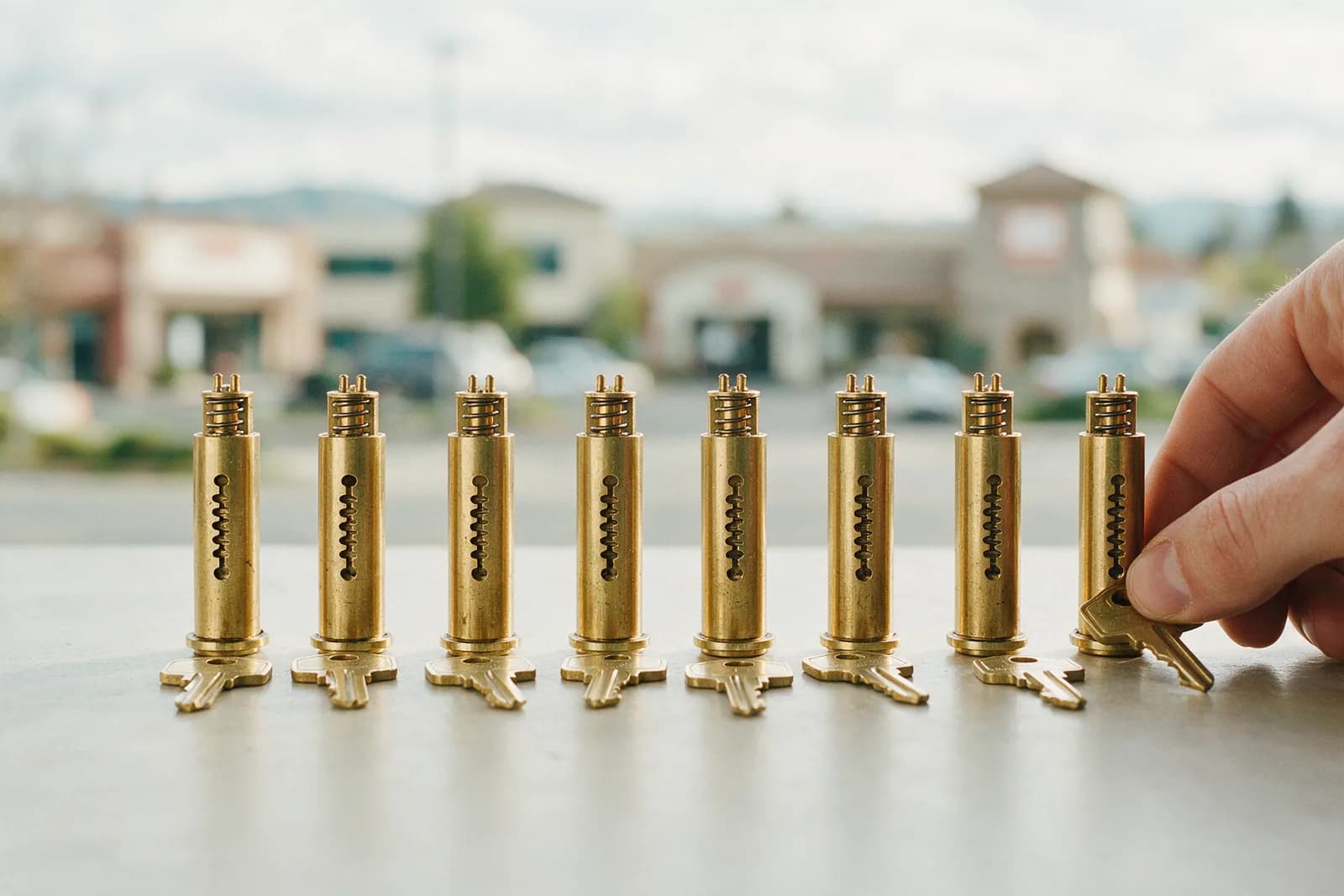
A master key system is a hierarchy built out of metal. Each key opens the door belonging to its holder and nothing beyond it. A master covers a floor, a row of suites or an entire site. Above that there is sometimes a grand master for an owner or a manager. Set up properly, a drawer of unlabeled keys turns into one key worth protecting. Set up carelessly, it issues keys that open doors nobody intended, which is a worse place to stand than having no system at all.
On a house here the chart is small and genuinely earns its keep, because there are nine doors and four sets of visitors. The gardener holds a key for the side gate and nothing else. The cleaning crew holds one for the garage service door. You carry a single blade that opens all nine, cellar and pool gate and the room over the garage included. Nothing has to be confiscated when somebody stops coming: the one cylinder they could reach gets repinned and the rest of the house never notices.
The commercial version lives out at Stoneridge and Hacienda, where one tenant may hold a front entrance, a rear door onto the yard, a shop floor, a parts cage and four offices, plus the electrical, telecom and janitor doors that no list in any office has ever covered. Downtown adds the Main Street buildings with shops below and offices above, where the street entrance, the stair and half a dozen suite doors have been collecting keys from every tenant since the eighties.
That is why nobody quotes this from a phone call. Every opening gets walked and counted first: what hangs in it, whether that cylinder can carry a pinning, who has to reach it, and which doors must stay off the chart entirely. There is always at least one of those and usually more than an owner expects. A gun safe closet. A records cabinet. A cellar with the irrigation controls in it. Condition matters as much as count, because a gate lock that has been outdoors since last summer often has to be cleaned or replaced before it can join a chart at all, and that is the line owners are most surprised by.
The chart is the real work and pinning it is an afternoon. Levels go on paper after the walk, a restricted keyway sits under the whole thing so nothing can be copied at a grocery store machine, and each cylinder is pinned at the bench with master pins stacked over change pins, then tried in its own door with both keys. Cylinders with life left are repinned into the chart instead of binned, which is normally the largest saving on the quote. Keys are stamped by level and signed for in a log. Pricing is one itemized quote after the walk, because door count, level count, keyway and the state of each cylinder move it further than any published range could cover. The $89 survey is the visit and it counts toward the work. A single door repinned later, when somebody stops coming, is $34 to $52 and stays inside the chart, which on a one-cylinder stop means $123 by day, $175 after eight and $217 overnight. Ninety days of warranty on the work.
“I hold a row of suites, and for years every door had a key of its own on a ring I hated carrying, plus a cleaning crew who needed into all of them and a tenant in each who should get into exactly one. He would not put a price on it over the phone. That annoyed me at the time and turned out to be the right answer. All eleven doors were walked with a notebook, each one opened, and what was actually hanging on it written down rather than what the lease claimed. Back came a chart and a price of $1,180 for the whole system, and the chart matches the building, which I now understand is not a given. Today I carry one key, each tenant carries one that opens their suite and the back corridor and nothing else, the cleaners carry one that opens the corridor and the utility room only. Cutting and fitting took a morning once the chart was agreed.”
All sixteen jobs are printed here, fourteen with ranges and two quoted once the doors have been walked. What moves a figure inside its range is which of the nine doors stopped you — a front door, a garage service door, a side gate, a pool gate, a cellar and a safe are six different pieces of work — and how long that particular door has gone unused. A front door somebody opens twice a day takes the low end. A gate latch nobody has walked through since last summer is dry, full of grit and often will not accept even the key that was cut for it, and that takes the time it is owed. Say which one stopped you and the range closes to a single figure.
- Daytime (7am–8pm)standard rates
- Evening (8pm–12am)+$52
- Overnight (12am–7am)+$94
FAQ
Master Key Systems: quick answers
This is a house, not a building. Is a chart overkill for nine doors?+
Nine doors and four sets of visitors is exactly the size where it pays. One blade in your pocket opens the lot. The gardener carries a key for the side gate alone, the cleaning crew one for the garage service door, and when somebody stops coming, a single cylinder gets repinned at $34 to $52 instead of the whole property being redone. The walk takes half an hour and the $89 counts toward the work.
Why can nobody give me a figure for this on the phone?+
Three things set the number: how many doors, how many levels the chart needs, and what shape each cylinder is in. A phone call supplies none of them, and the third bites hardest here, because outdoor gate cylinders often need work before they can join a chart. A figure given without the walk is a guess, and the correction shows up once half the cylinders are on the bench.
Our property manager left and the master for the building never came back.+
The chart says precisely which doors that key reached, so the repinning stops there and nothing else has to move. Change keys and any sub-masters under them keep working. Because the keyway is restricted, no counter machine ever cut a copy, so what is loose is one key rather than an unknown number of them. Door count sets the price and you have it before the work starts.
Related
More commercial services
Open 24 hours, 7 days
Name the door, and say how long since anyone used it
Pleasanton, whatever the hour, every day of the year. An entry in the tracts, a seized gate latch on a hill street, a pool gate, a safe left behind by the last owners, a shop door on Main, a car sitting in the Stoneridge lot — that is what decides the work, and the work decides the figure. You get that figure on this call with the $89 drive and the clock already inside it, and it is the figure on the invoice. Ninety days on the labor, in writing. The van is a few doors off Main.