Access Control in Pleasanton
No published figure, because a reader on a hollow aluminum leaf and a reader on a solid door with a closer are two different jobs at two different prices, and the only way to tell them apart is to stand in front of them. Electric strikes, keypads and card entry for suites and small offices, sized to the door rather than to a catalog. Each door is left with a working cylinder underneath the electronics and a metal key that has actually been cut for it, which is the step most installers skip and the one that matters the Sunday a reader dies. Where a building already runs a system, the roster of who is allowed through stays with the people managing it.
4.9 / 5· 274 reviews from Pleasanton and the Tri-Valley
custom quote
Typical price
19 min
Avg. arrival
24/7
Availability
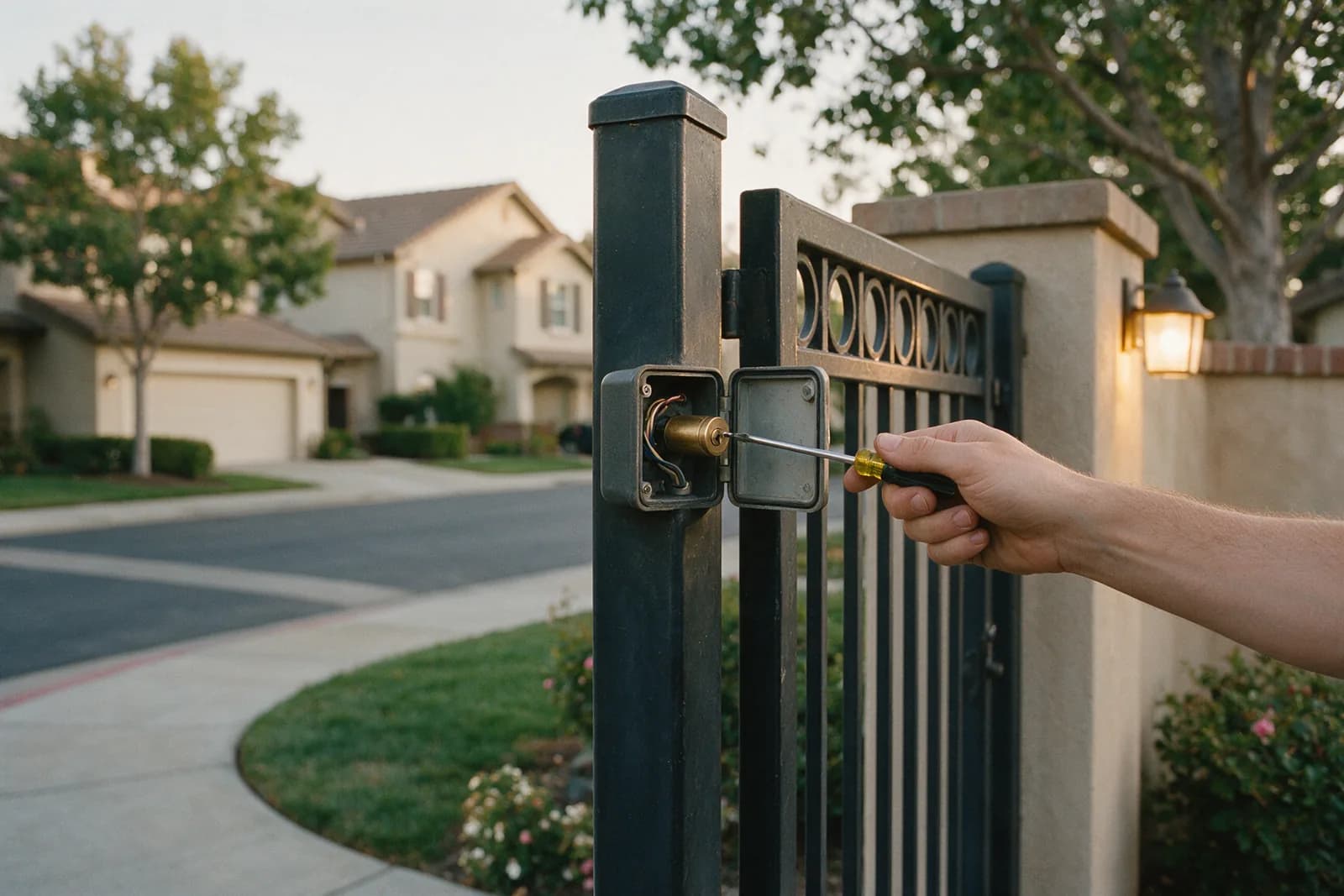
A key, once handed over, cannot be recalled. A card gets switched off from a desk on a Sunday evening. That one difference carries this entire page, and it is an argument about administration far more than about security. It is also the wall a nine-door property eventually runs into, with metal out at a gardener, a cleaning crew and every contractor from the last remodel and no way to count it.
What is covered here is the door end: keypads and card entry, electric strikes and magnetic locks, exit sensors and release buttons, the hardware carrying them and the cable at the opening. Two exclusions, said here so they are not a surprise later. Nothing is sold under the name of a controller, an intercom or an app belonging to another company. And where a property already runs a system, a community gate at Ruby Hill, a garage at an apartment block, an entrance at an office park, the cards and remotes on it are issued and canceled by whoever administers it, not by a locksmith. No access list is held here and nobody is told who gets to be on one.
The survey walks door to door and writes down three things: what the leaf is made of, what is hanging on it today, and how far off the nearest power and network are. Those three answers choose the hardware; a catalog page does not. Wood or hollow metal in a deep frame takes an electric strike. Aluminum and glass with a stile too narrow for a strike takes a magnetic lock at the head, a motion sensor above the leaf and a release button beside it. A gate across a drive gets wired to the operator already sitting there rather than handed a new one, and the pedestrian leaf next to it keeps a key. The controller is sized past today, with positions left open for the doors somebody adds next year.
On every property one door keeps a mechanical cylinder on a restricted key, and that is a design decision rather than a hedge. Up the Foothill side, a power cut with no metal key anywhere on the lot means standing outside your own gate with the groceries. On a commercial site it means a crew in the parking lot at seven. Let the electronics run the place day to day. Something still has to open a door on the morning they refuse, and that cylinder gets serviced on a schedule instead of being remembered only when it has gone stiff.
Pricing is per project after the walk, itemized door by door, with hardware, controller, cards and labor each on a line so nothing disappears into a lump. The $89 survey counts toward the work. Once approved, the quote holds, and a door that turns out to need fresh preparation is explained and agreed as its own line rather than appearing on the invoice at the end. The figures that exist in the open are the emergency ones: opening a commercial door with the power out is $148 by day, $200 past eight in the evening and $242 between midnight and seven, each with the call inside it. Ninety days of warranty on anything installed.
“We took a suite with two doors needing card entry: a hollow aluminum leaf onto the corridor and a solid door with a closer into the back. The first company gave us $4,800 on a phone call having never set foot in the place, which in hindsight explains a lot. Amador refused to price anything until both doors had been looked at, and the walk-through ran about forty minutes. The quote came back at $2,460 for the two, itemized by door, and that is what we paid. Nobody else raised the thing that has since mattered most: each door kept a working mechanical override cylinder on a key we actually hold, so a reader dying on a Sunday does not shut four people out of their own office. He was equally clear that the roster of who gets in stays with our property manager and is not something he would ever touch. Two months on, both doors have been faultless and the closer on the back one has stopped slamming.”
All sixteen jobs are printed here, fourteen with ranges and two quoted once the doors have been walked. What moves a figure inside its range is which of the nine doors stopped you — a front door, a garage service door, a side gate, a pool gate, a cellar and a safe are six different pieces of work — and how long that particular door has gone unused. A front door somebody opens twice a day takes the low end. A gate latch nobody has walked through since last summer is dry, full of grit and often will not accept even the key that was cut for it, and that takes the time it is owed. Say which one stopped you and the range closes to a single figure.
- Daytime (7am–8pm)standard rates
- Evening (8pm–12am)+$52
- Overnight (12am–7am)+$94
FAQ
Access Control: quick answers
A remote for our community gate stopped working. Can you make another one?+
Not a locksmith job, and hearing it now saves you a trip charge. Remotes for a community gate sit on a list the association or its manager keeps, and only that desk can issue or cancel one. The mechanical side of the same address is ours: the cylinder in the pedestrian gate beside it, the mail block, your own side gate, serviced, repinned or opened when the power is out. Authority for that order gets settled on the call.
Keys keep going out to gardeners and contractors and never coming back. Would this stop it?+
On the doors carrying the traffic, yes. Killing a code or a card takes a minute at a screen, while a key that never returned means repinning every cylinder it turned at $34 to $52 apiece. On a nine-door property the sensible split is electronics on the two or three doors used weekly, metal on the rest, and one restricted cylinder kept alive for the day the power goes.
Do we give up keys entirely?+
No, and trying would be a poor idea. One door keeps a mechanical cylinder on a restricted key, because boards fail and power goes out, and out toward Castlewood and Ruby Hill there is no neighbor close enough to improvise with. That cylinder gets serviced on a schedule as well, which is the part everybody forgets until the morning it matters.
Related
More commercial services
Open 24 hours, 7 days
Name the door, and say how long since anyone used it
Pleasanton, whatever the hour, every day of the year. An entry in the tracts, a seized gate latch on a hill street, a pool gate, a safe left behind by the last owners, a shop door on Main, a car sitting in the Stoneridge lot — that is what decides the work, and the work decides the figure. You get that figure on this call with the $89 drive and the clock already inside it, and it is the figure on the invoice. Ninety days on the labor, in writing. The van is a few doors off Main.